
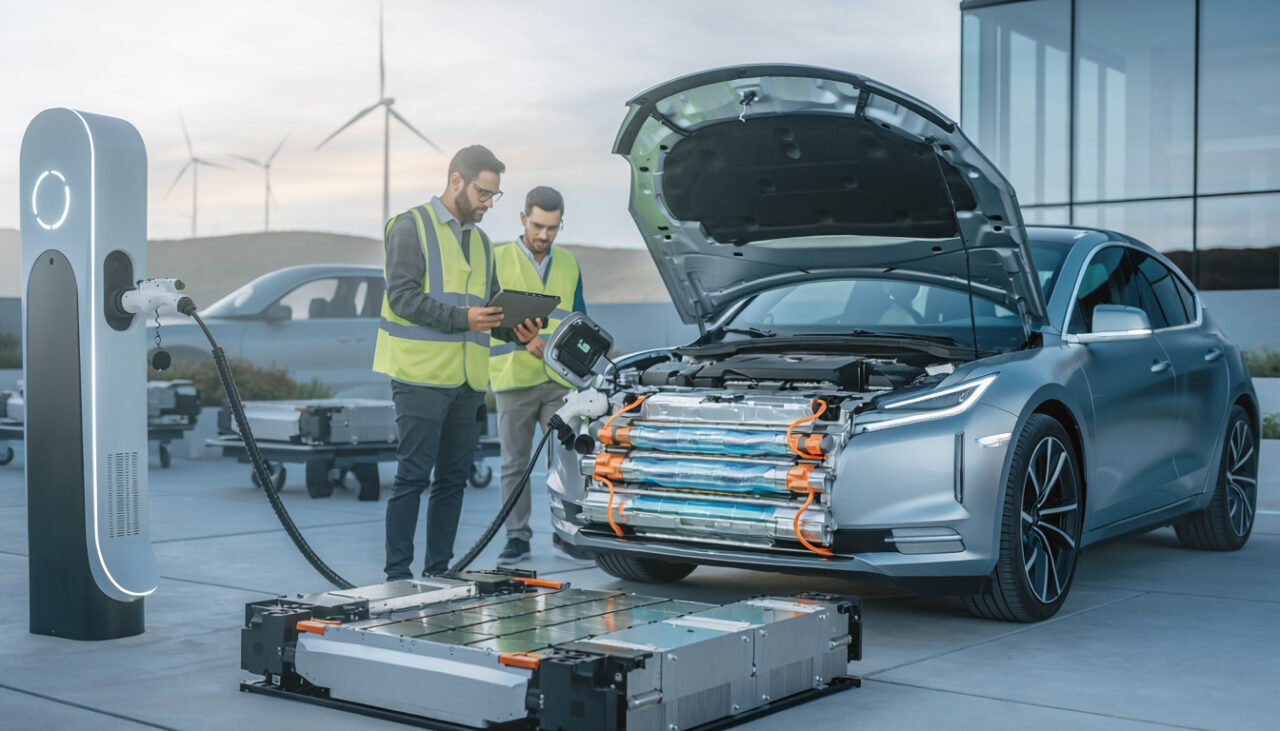

New battery chemistries with high‑temperature‑stable electrolytes and advanced coatings cut heat‑induced loss to a few percent under a 2 °C rise, far less than the 30 % seen in older cells. Smaller packs with high thermal conductivity and micro‑channel cooling reduce cooling demand and warm up faster, preserving range in hot climates. Sodium‑ion and solid‑state cells add low‑cost, long‑cycle options and ultra‑fast charging while improving safety. AI‑driven telemetry and digital twins enable predictive maintenance, extending life and real‑world range, and upcoming sections reveal deeper details.
Key Takeaways
- Advanced electrode chemistries and high‑performance electrolyte additives keep capacity stable, losing only a few percent with a 2 °C temperature rise.
- Integrated micro‑channel cooling and liquid gap fillers maintain uniform cell temperatures, preventing hotspots during high‑C bursts.
- Smaller, low‑thermal‑mass packs cool faster and consume less energy, reducing heat‑induced degradation and extending battery life.
- Sodium‑ion and solid‑state cells offer lower cost, higher safety, and ultra‑fast charging, delivering up to 1,000 km range in minutes.
- Cell‑to‑pack designs and dropping battery prices (now near $100/kWh) make EVs more affordable while preserving or improving performance.
EV Battery Trends: Climate‑Resilient Cells Reduce Heat Degradation
In recent years, EV battery trends have shifted toward climate‑resilient cells that mitigate heat‑induced degradation. Advanced electrode formulations, high‑performance electrolyte additives, and refined coating processes now deliver thermal resilience that curtails parasitic reactions at elevated temperatures. Modern cells retain capacity far better than 2010‑18 models, losing only a few percent under a 2 °C rise versus up to 30 % in earlier generations.
Integrated micro‑channel cold plates and liquid gap fillers maintain uniform temperature, while system‑level conductivity above 3 W/m·K prevents internal spikes during 6 C bursts. These chemistry and design gains translate into measurable lifespan extensions, especially in tropical markets where older batteries once suffered severe heat‑related wear.
The result is a unified, climate‑adapted platform that reassures owners of reliable, long‑lasting performance. Battery lifetime is projected to decline by up to 8 % under 2 °C warming for older chemistries. Recent analysis of 300 global cities shows that new batteries experience only a 3 % average lifetime drop under the same warming scenario. Core‑to‑surface temperature gradients must be actively estimated using physics‑based models to prevent hidden overheating.
Do Smaller Battery Packs Keep Their Edge in Warm Cities?
Leveraging reduced thermal mass, smaller battery packs consume less cooling power and stabilize temperature more quickly, offering a measurable advantage in warm urban environments. Their lower capacity translates into proportionally reduced heat‑induced degradation, a key benefit for city drivers who frequently recharge.
In typical summer heat, range loss averages 5 % at 90 °F, primarily from HVAC demand; smaller packs draw less energy for cabin preconditioning, preserving usable mileage. Drivers who practice shade parking further limit ambient heat exposure, extending pack life and maintaining performance.
The rapid thermal response of compact packs also supports quicker warm‑up after short trips, keeping efficiency high. Consequently, smaller battery packs retain a competitive edge in warm cities, aligning with community expectations for reliable, cost‑effective mobility. Cold‑weather range loss is mitigated when preconditioning is performed while the vehicle is plugged in, preserving battery SOC for the trip. Altitude reduces drag in higher‑elevation areas, further enhancing range.
Smaller Battery Packs Lower EV Prices for Daily Drivers
A modest reduction in battery pack size can cut vehicle prices dramatically for everyday commuters. By trimming capacity to meet typical urban range needs, manufacturers lower material usage and eliminate expensive high‑density cells.
Current data show pack prices falling from $115/kWh in 2024 to $108/kWh in 2025, with entry‑level models already below $100/kWh. Cell‑to‑pack designs and the shift to low‑cost LFP chemistry further reduce cost, a LFP creating $50/kWh packs and $36/kWh cells in competitive markets.
Cost‑sensitive buyers benefit from these savings, as smaller packs still deliver sufficient range for daily driving while enabling price parity with gasoline vehicles. This pricing pressure accelerates market adoption and strengthens the sense of community among urban EV owners. China’s average battery prices dropped 13% in 2025 to $84/kWh. Battery prices have declined every year since 2010, underscoring the sustained momentum of cost reductions. The record low of $108/kWh reflects a broader industry trend of price compression despite rising raw‑material costs.
EV Battery Trends: Sodium‑Ion Offer Low‑Cost, 10 000‑Cycle Power
Sodium‑ion batteries are emerging as a low‑cost alternative that can endure up to 10 000 charge cycles while delivering roughly 250 miles of range on the CLTC test cycle.
Recent certifications of CATL’s Naxtra pack and mass production of the Changan Nevo A06 demonstrate that sodium‑ion technology now meets automotive standards for cycle‑stability and safety. Abundant sodium resources enable material‑sourcing that reduces reliance on geopolitically sensitive lithium supplies, driving cost‑parity with conventional lithium‑ion cells.
Performance tests show over 90 % capacity retention at –40 °C and minimal thermal‑runaway risk, reinforcing durability for urban commuters.
While energy density remains lower than lithium‑ion, the combination of affordable pricing, robust cycle‑life, and stable operation fosters a sense of collective progress among manufacturers and consumers.
Winter testing in Inner Mongolia confirmed reliable charging at −30 °C and operation down to −50 °C.
EV Battery Trends: Solid‑State Cells Promise Safer Fast Charging by 2026
Amid mounting safety concerns over liquid‑electrolyte lithium‑ion packs, solid‑state batteries are emerging as a low‑risk alternative that can support ultra‑fast charging by 2026. By eliminating flammable liquid electrolytes, they dramatically lower the chance of thermal runaway.
Recent prototypes—Dongfeng’s 350 Wh/kg cell retaining 72 % capacity at –30 °C and BYD’s FinDreams line stable at –40 °C—demonstrate robust low‑temperature performance.
Energy density is climbing toward 400–500 Wh/kg, with Changan’s “Golden Bell” at 400 Wh/kg and Chery’s “Rhino” series reaching 600 Wh/kg, enabling 1,000‑plus km ranges.
Fast‑charging targets are equally aggressive: Toyota’s solid‑state packs aim for 10‑80 % SOC in ten minutes, while BYD’s 1,500 kW stations promise 10‑70 % in five minutes.
Success hinges on advanced interface engineering, which secures ion transport and longevity, positioning solid‑state cells as the safer, faster future for EVs.
AI Predictive Maintenance Adds Real‑World Range
By integrating AI‑driven predictive maintenance, manufacturers can translate real‑time battery diagnostics into tangible range gains for electric vehicles. AI models ingest voltage, temperature, and current streams while correlating driver behavior and environmental factors, producing precise State‑of‑Charge and State‑of‑Health estimates. Early detection of cell anomalies triggers proactive interventions, preventing performance loss before it manifests.
Continuous degradation forecasting refines remaining‑useful‑life calculations, allowing dynamic range predictions that stay accurate as batteries age. Adaptive thermal management, informed by the same diagnostics, keeps cells within ideal temperature windows, reducing energy waste. Maintenance schedules shift from fixed intervals to health‑based triggers, minimizing downtime and repair costs. This data‑centric approach cultivates confidence among owners, reinforcing a shared commitment to efficient, reliable EV ownership.
Digital Twins Speed Up New Battery Designs
Through real‑time integration of sensor streams, digital twins create virtual replicas that mirror the exact health of lithium‑ion packs, enabling instantaneous assessment of state‑of‑health and state‑of‑power. By continuously feeding telemetry into reduced‑order models, engineers achieve model reduction that compresses complex electro‑chemical behavior into seconds‑scale simulations.
This capability fuels virtual prototyping, allowing designers to test thermal, mechanical, and electrical scenarios without physical builds. Predictive forecasts identify degradation pathways, cutting maintenance expenses by over 50 % and preventing hazardous failures such as thermal runaway.
The rapid iteration cycle shortens development timelines, delivering higher‑energy cells that meet regulatory standards while fostering a collaborative community where each stakeholder feels integral to the EV evolution.
How Top EV Makers Are Scaling High‑Energy Batteries and What It Means for Your Daily Range
In the race to extend everyday driving distances, leading Chinese manufacturers are rapidly scaling solid‑state and next‑generation lithium‑ion technologies that push energy density well beyond 400 Wh/kg, delivering CLTC ranges of 1,000 km to 1,500 km and enabling ultra‑fast charging solutions that reshape daily EV usability.
Changan’s Golden Bell battery hits 400 Wh/kg, promising 1,500 km range and positioning the brand as a pioneer in pack scaling. Dongfeng’s 350 Wh/kg prototype validates cold‑climate reliability above 1,000 km. Chery’s Rhino series reaches 600 Wh/kg, delivering 1,500 km for ultra‑long trips. BYD’s Blade Battery 2.0 couples LFP safety with 1,500 kW flash charging, achieving 1,000 km in minutes. Factorial Energy’s Solstice platform, at 450 Wh/kg, extends range by 50 % across partners, reshaping range psychology for daily drivers.
References
- https://www.eurekalert.org/news-releases/1118032
- https://www.greencars.com/news/smaller-batteries-could-be-the-most-important-ev-shift-of-2026
- https://natlawreview.com/press-releases/first-life-ev-battery-market-2026-manufacturers-strengthening-primary
- https://www.icertglobal.com/blog/how-new-technologies-improve-ev-performance-in-2026
- https://en.highstar.com/blog/next-generation-batteries-2026-beyond
- https://cen.acs.org/materials/energy-storage/battery-EV-battery-climate-change/104/web/2026/03
- https://news.umich.edu/improved-ev-battery-technology-will-outmatch-degradation-from-climate-change/
- https://www.acdcecfan.com/ev-battery-thermal-management-blueprint-2026/
- https://www.thecooldown.com/green-tech/geely-solid-state-battery-technology-automakers-push-production/
- https://www.youtube.com/watch?v=9kYsRjmf7AY