
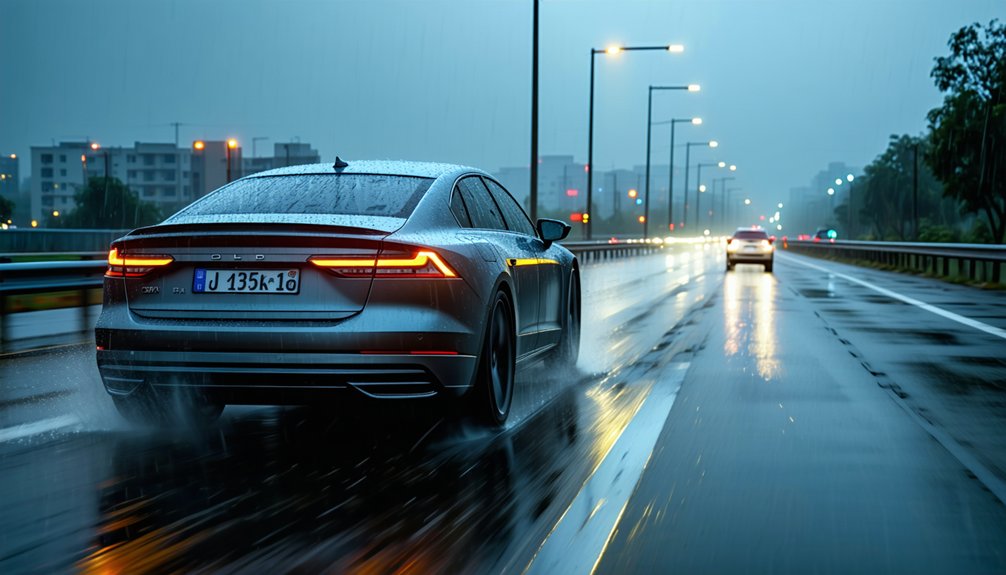

Safety‑assist systems lower crashes by detecting hazards earlier and intervening automatically. Front‑crash prevention and AEB stop collisions before driver reaction, cutting forward‑crash rates by over 50% in recent models. Pedestrian‑detection sensors and adaptive headlights improve visibility, reducing vehicle‑pedestrian crashes by up to 23%. V2V communication extends perception beyond line of sight, preventing rear‑end impacts, while AI‑driven driver coaching trims harsh events and phone distraction by more than 80%. Continued exploration reveals deeper insights.
Key Takeaways
- Front‑crash prevention and AEB systems now engage pre‑charge and auto‑brake up to 62 mph, cutting forward‑collision incidents by up to 52 % versus earlier models.
- Pedestrian‑detecting AEB, using camera‑radar‑lidar fusion and AI, reduces pedestrian crashes by 9 % and prevents an estimated 5,000 vehicle‑pedestrian collisions annually.
- Vehicle‑to‑vehicle (V2V) communication extends perception beyond line‑of‑sight, lowering forward‑collision conflicts by 9 % and projected to mitigate up to 80 % of non‑impaired rear‑end crashes.
- Adaptive driving‑beam headlights improve nighttime illumination by up to 86 % and are linked to 19 % fewer single‑vehicle crashes and 23 % fewer pedestrian collisions.
- AI‑driven driver coaching with real‑time alerts and video feedback reduces harsh events by 48 % in six months and overall crash rates by 75 % over 30 months in fleet deployments.
IIHS 2026 Top Safety Pick+ Criteria Explained
A handful of stringent benchmarks define the 2026 IIHS Top Safety Pick+ criteria, beginning with crash‑test performance.
Vehicles must achieve good ratings in small‑ and moderate‑overlap front tests, the latter now emphasizing rear‑seat and child‑protection outcomes.
Side‑impact scores are also required, ensuring that crumple structures absorb energy while preserving cabin integrity.
Material choices influence deformation pathways, directing forces away from occupants and safeguarding the back seat.
Headlights must be acceptable or good across all trims, guaranteeing night‑time visibility for the community of drivers.
Pedestrian‑front crash prevention systems are mandatory, reflecting a collective commitment to urban safety.
These unified standards foster a sense of belonging among consumers who prioritize thorough protection for families and fellow road users.
More than 77% of 2026 models meet the vehicle‑to‑vehicle crash avoidance standard. 63 vehicles qualify for IIHS awards in 2026, up from 45 at this point in 2025. The 2025 Honda Accord is one of the models that earned the Top Safety Pick+ designation.
Why Front‑Crash Prevention Is Mandatory for Top Safety Pick+?
Crash‑test performance sets the baseline, but the IIHS now requires front‑crash prevention systems to be standard and rated good for a vehicle to earn the Top Safety Pick+ badge.
The policy rationale reflects a shift from merely acceptable scores to a mandatory good rating in pedestrian and vehicle‑to‑vehicle tests, ensuring that every trim level offers the highest level of active protection.
This regulatory alignment with the updated IIHS criteria—good pedestrian front‑crash prevention, acceptable or good vehicle‑to‑vehicle 2.0, and good moderate‑overlap front results—creates a uniform safety floor across the market. 2026 IIHS awards show that 45 vehicles earned Top Safety Pick+ while 18 earned Top Safety Pick, underscoring the expanding impact of these standards. No minivans earned awards highlight the importance of rear‑seat safety evaluations. The new vehicle‑to‑vehicle front crash prevention test adds three approach‑speed scenarios and three target types, demanding timely warnings and substantial slowing or avoidance.
How Automatic Emergency Braking Cuts Front‑Crash Collisions
Cutting front‑crash collisions, Automatic Emergency Braking (AEB) leverages cameras, radar, and lidar to detect imminent threats and apply brakes before the driver can react.
Recent data shows AEB effectiveness rising from 46 % in 2015‑17 to 52 % in 2021‑23 models, with 2024 vehicles avoiding forward collisions 100 % at 12, 25, 35 mph versus 73 %, 47 %, 33 % in earlier releases.
Speed thresholds determine intervention timing; systems now engage pre‑charge and auto‑brake up to 62 mph as mandated by NHTSA.
Studies report 43‑68 % fewer rear‑end crashes when AEB couples with forward‑collision warning, and a 41 % reduction for large trucks.
Consistent gains across cars, SUVs, pickups, and trucks reinforce AEB as a core safety pillar, fostering collective confidence in road safety.
The study also found that pedestrian AEB reduced single‑vehicle frontal crashes involving non‑motorists by 9 %.Pickups are more than 2½ times as likely to kill the driver of a struck car in a two‑vehicle crash.
Overall crash risk for vehicles equipped with AEB and pedestrian or bicyclist detection is reduced by roughly 20 % across the dataset.
Pedestrian‑Detection Tech That Boosts Top Safety Pick+ Scores
How does pedestrian‑detection technology elevate Top Safety Pick+ ratings? Advanced systems integrate thermal fusion and high‑resolution imaging, delivering 92‑94% detection accuracy at midblocks and signalized intersections.
AI‑driven convolutional networks cut false positives to 2%, while predictive analytics anticipate pedestrian trajectories, enabling pre‑emptive braking.
Nighttime sensing benefits from thermal sensors, preserving 90% accuracy in low‑light scenarios where 75% of pedestrian fatalities occur.
The technology reduces an estimated 5,000 vehicle‑pedestrian crashes and 810 fatal incidents annually, accounting for 8% of all pedestrian crashes and 24% of fatal ones. Hardware now accounts for 73% of total market value, underscoring the importance of sensor and processor integration.
Vehicle‑to‑Vehicle Communication to Prevent Rear‑End Crashes
Through real‑time exchange of speed, location, and heading data within a 300‑meter radius, vehicle‑to‑vehicle (V2V) communication equips following drivers with instantaneous warnings of sudden braking or emerging hazards, effectively shortening reaction time and enabling pre‑emptive braking.
The system transmits updates ten times per second via DSRC, keeping V2V latency low enough for cooperative braking to engage before a driver can react.
By extending perception beyond line of sight, V2V alerts drivers when a vehicle enters the critical safe distance, complementing radar and camera inputs.
Pilot studies report a 9 % reduction in forward‑collision conflicts, and regulatory mandates project up to 80 % mitigation of non‑impaired rear‑end crashes, reinforcing a shared commitment to road safety.
AI‑Powered Driver Coaching Reduces Real‑World Crash Rates
Vehicle‑to‑vehicle communication extends a driver’s situational awareness beyond line of sight, but the greatest safety gains arise when that data is paired with AI‑driven coaching that corrects risky behavior in real time.
AI coaching delivered through dual‑facing dash cams has proven to cut crash rates dramatically. Fleets using the full Samsara AI suite report a 75 % Crash reduction over 30 months, with 175‑vehicle fleets achieving 73 % lower incidents.
Early gains are evident: harsh events drop 48 % in six months and 69 % by month 30, while mobile phone use falls 84 % then 96 %. Real‑time alerts, video‑backed feedback, and post‑trip analysis reinforce safe habits, creating a shared culture of vigilance that sustains long‑term safety improvements.
Affordable $30K‑Plus Models That Earn Top Safety Pick
Typically, consumers seeking high‑level protection no longer need to exceed a $30,000 budget, as the 2026 IIHS Top Safety Pick+ list includes more than a dozen models priced below that threshold. Budget sedans such as the Kia K4, Mazda 3, Nissan Sentra and Hyundai Elantra achieve Good ratings in moderate and small overlap front tests while offering standard front‑crash prevention.
Compact crossovers like the Hyundai Kona, Honda HR‑V and Mazda CX‑30 extend that safety envelope to small SUVs, meeting side‑impact criteria and providing acceptable headlights across all trims. Across 45 qualifying vehicles, manufacturers demonstrate that robust crashworthiness and advanced driver‑assist systems are no longer exclusive to premium price tags, fostering a community of safety‑focused owners who share confidence and value.
Adaptive Headlights and Their Role in Top Safety Pick+ Success
By automatically dimming high‑beams for oncoming traffic, adaptive driving‑beam (ADB) systems transform nighttime visibility and directly contribute to the Top Safety Pick+ designation.
Adaptive headlights increase roadway illumination up to 86 % over low‑beams, sharpening detection of pedestrians, animals, and obstacles. Studies link good‑rated headlights to 19 % fewer single‑vehicle crashes and 23 % fewer pedestrian collisions, while curve‑adaptive units cut claim rates by 10‑15 %.
Integration with lane‑keeping and emergency‑braking amplifies these gains, and NHTSA’s final rule endorses ADB for new models.
Effective driver education reinforces proper use, ensuring motorists recognize the system’s automatic adjustments.
Collectively, these technologies reduce glare‑related fatigue, elevate safety statistics, and reinforce the community identity of Top Safety Pick+ owners.
References
- https://www.iihs.org/news/detail/iihs-pushes-improvements-in-crash-avoidance-with-2026-awards
- https://www.nhtsa.gov/ratings/2026-model-year-vehicles-selected-testing-nhtsa
- https://www.worktruckonline.com/10256539/lytx-2026-road-safety-report-reveals-critical-collision-trends
- https://saferoads.org/2026-roadmap-to-safety-press-release/
- https://www.thetrucker.com/trucking-news/the-nation/lytx-2026-road-safety-report-reveals-critical-collision-trends-and-urgent-fleet-risk-insights
- https://www.youtube.com/watch?v=zLvQCujzUok
- https://www.ccjdigital.com/technology/article/15814836/2026-motive-ai-road-safety-report-highlights-collision-indicators
- https://www.trafficsafetystore.com/blog/traffic-safety-2025-review-key-trends-2026-outlook/
- https://www.automotiveworld.com/news/tougher-crash-avoidance-rules-shape-2026-iihs-awards/
- https://www.iihs.org/ratings/top-safety-picks