
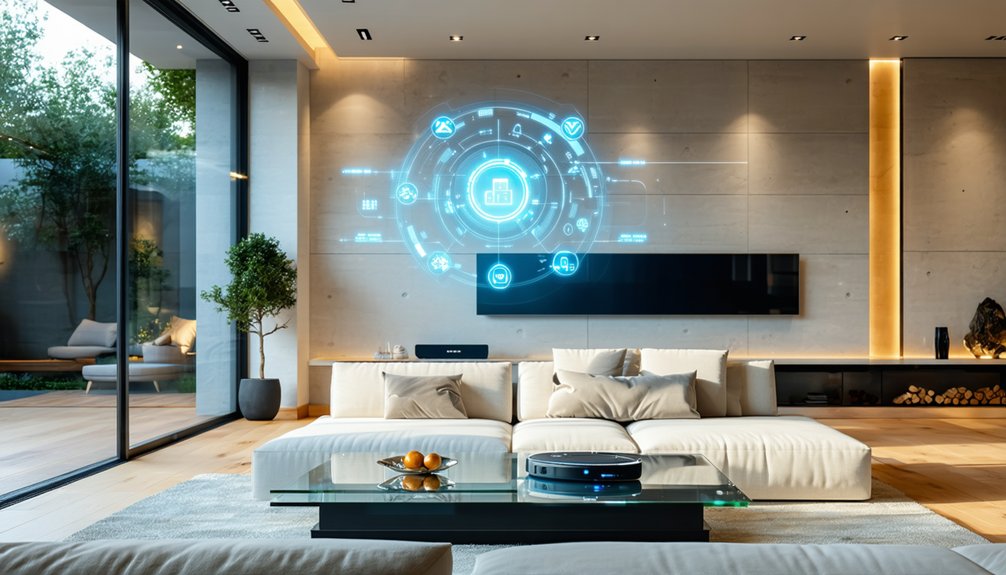

Smart homes now fuse energy‑management, security, lighting, climate control, and voice‑activated hubs into a single AI‑driven ecosystem. The Matter standard guarantees cross‑manufacturer communication, while 5G and IoT provide sub‑millisecond latency for real‑time actuation. Edge computing processes sensor data locally, cutting bandwidth and enhancing responsiveness. AI forecasts energy use, shifting loads to off‑peak periods and personalizing comfort. Together these technologies create a seamless, cost‑saving experience that scales toward a projected $1.4 trillion market. Continued exploration reveals deeper insights.
Key Takeaways
- Matter provides a universal, IP‑based protocol that lets devices from different brands discover, pair, and control each other locally and securely.
- 5G and edge computing deliver sub‑millisecond latency and local processing, enabling real‑time coordination of lighting, climate, and security systems.
- AI‑driven energy‑management forecasts optimize appliance usage and integrate with solar and battery storage to cut household utility bills by up to 30%.
- Integrated hubs and bridges unify legacy Zigbee or Thread devices into the Matter ecosystem, preserving existing investments while expanding functionality.
- Whole‑home integration creates a cohesive user experience, where security alerts, climate adjustments, and lighting scenes are orchestrated through a single, cloud‑synced platform.
What Makes Smart Homes Worth the Hype? – Core Benefits and Market Drivers
Why do smart homes command such intense attention? The answer lies in a convergence of measurable cost savings and heightened security convenience that resonates with consumers seeking community and peace of mind. Global market data shows a 23.1 % CAGR through 2032, with North America alone holding 31.7 % of the share, underscoring rapid adoption.
Energy‑management systems cut utility bills by 25–30 %, translating to $1,500–$3,000 saved per household annually. Integrated security devices—cameras, smart locks, and hubs—deliver real‑time protection while simplifying daily routines. The rise of Matter enables seamless communication across devices, reducing ecosystem fragmentation and boosting consumer confidence. Together, these benefits drive a surge in active smart‑home households, now projected at 672 million by 2027, and reinforce the perception that smart homes are not a luxury but an essential, belonging‑enhancing investment. The U.S. market alone is expected to reach $52.19 B by 2027, reflecting a 10.22 % CAGR. The global smart home market is projected to reach $1.4 trillion by 2034.
How the Matter Standard Solves Smart‑Home Interoperability
The surge in cost savings and security benefits highlighted in the previous discussion creates a clear demand for seamless device interaction, a need that the Matter standard directly addresses.
Matter, an open IP‑based framework backed by Apple, Google, Samsung, Amazon and over 200 partners, unifies discovery through mDNS, IPv6 and Bluetooth Low Energy, enabling local interoperability without proprietary hubs. Devices announce readiness via auto‑discovery, allowing secure commissioning through QR codes or pairing keys, and they operate primarily on‑premises, preserving functionality during internet outages.
Certification guarantees cross‑manufacturer communication, so a Govee light can be controlled from any Matter‑enabled controller. Bridges extend legacy Zigbee or SwitchBot accessories, ensuring future purchases remain compatible and reinforcing a cohesive, belonging‑focused smart‑home ecosystem. Industry‑unifying standard delivers a seal of approval that devices will work seamlessly today and tomorrow. Matter’s local‑first design ensures devices remain functional even when the internet is down.
Why 5G & IoT Matter for Real‑Time Smart‑Home Control
Accelerating smart‑home responsiveness, 5G and IoT together deliver sub‑millisecond latency, massive device density, and gigabit‑class throughput that transform everyday appliances into real‑time actuators. This ultra‑low latency enables commands to lights, thermostats, and security locks to execute instantly, while voice assistants leverage cloud intelligence without perceptible delay. Network slicing allocates dedicated bandwidth to critical control streams, preventing interference from bandwidth‑hungry media. Edge orchestration processes sensor data locally, reducing round‑trip time and extending battery life across hundreds of devices per square kilometer. The result is a seamless, proactive environment where climate, lighting, and safety systems adjust in real time, fostering a sense of belonging through reliable, instantaneous interaction. 5G’s enhanced network capacity supports the simultaneous operation of thousands of devices in a single household without performance degradation. Optimized device synchronization ensures multiple smart gadgets operate together without slowdown. Smart thermostats learn occupants’ schedules to pre‑condition rooms before arrival.
Top Smart‑Home Device Categories That Anchor Integrated Homes
Integrated home ecosystems hinge on five core device categories—security, lighting, climate control, hubs/networking, and automation—each providing the functional anchors that enable seamless, real‑time interaction across the household.
Security devices such as Vivint platforms, Nest Protect, Wyze Cam, and Kangaroo sensors form a resilient perimeter, while Aqara T1 perimeter sensors trigger automated routines that reinforce safety.
Lighting is anchored by Philips Hue, LIFX SuperColor, and Lutron Caseta, which synchronize ambience through Matter bridges and smart kits.
Climate comfort is managed by Ecobee SmartSensors that adjust temperature based on occupancy and predictive scheduling.
Voice hubs like Apple HomePod mini and Amazon Echo Show 5 serve as conversational control points, unifying device commands.
Automation devices, exemplified by SwitchBot Onero H1, translate voice and app inputs into coordinated actions, completing the integrated home experience. Battery‑free locks like the Lockin V7 Max eliminate the need for battery maintenance in security systems.
How AI Predicts Energy Use & Personalizes Comfort
Predicting household energy consumption and tailoring indoor comfort now rely on sophisticated AI models that ingest weather forecasts, solar generation data, and real‑time appliance usage. These systems deliver predictive comfort by learning occupancy patterns, preferred temperatures, and lighting levels, then automatically adjusting HVAC, blinds, and smart plugs. Appliance forecasting identifies high‑energy loads, shifts them to off‑peak windows, and coordinates with battery storage to balance solar output and grid demand.
In Europe and Australia, AI‑driven HEMS have achieved up to 28 % savings, while 80 % of experienced users cite proactive AI notifications as essential for reliability. Smart thermostats dominate market share, and recent Alexa and Powerwall upgrades illustrate how deep‑learning analytics translate into tangible cost reductions and a shared sense of energy stewardship.
Regional Adoption Trends You Must Know – North America, Asia‑Pacific, Europe
How do regional dynamics shape the surge of smart‑home adoption?
In North America, a market valued at USD 48.3 billion in 2025 expands to USD 89.7 billion by 2034, driven by high disposable incomes and policy incentives that reward energy‑efficient thermostats and lighting. Urban adoption reaches 64 % of households, with projected penetration of 68.64 % by 2027.
Asia‑Pacific leads growth at a 16.5 % CAGR, fuelled by rapid urbanization, a robust manufacturing base, and government support for IoT infrastructure that integrates smart‑home devices into smart‑city initiatives.
Europe mirrors this trajectory, emphasizing sustainability, regulatory standards, and policy incentives that boost thermostat and lighting uptake.
Together, these regions illustrate a coordinated, global shift toward connected, energy‑saving homes.
Key Barriers to Smart‑Home Growth – Cost, Standards, and Scaling to $1.4 T
The rapid expansion of the smart‑home market confronts three fundamental obstacles that together cap its trajectory toward the projected $1.4 trillion valuation: prohibitive upfront costs, fragmented standards, and the difficulty of scaling secure, interoperable ecosystems.
High upfronts for premium devices and whole‑home wiring often exceed $30,000, deterring price‑sensitive buyers and limiting penetration in emerging Asia‑Pacific economies.
Interoperability gaps arise from competing protocols, generating over 60 % of support calls and eroding consumer confidence. While the Matter initiative promises unified communication, regional regulatory variance sustains fragmentation.
Simultaneously, rising cyber‑threats and privacy anxieties amplify perceived risk, slowing adoption among households seeking seamless, trustworthy integration.
Future Outlook: From Whole‑Home Automation to a $1.4 Trillion Market
Overcoming high upfront costs, fragmented standards, and scaling challenges sets the stage for a market poised to exceed $1.4 trillion.
Analysts project total smart‑home automation revenue of $1,359 billion by 2035, driven by rapid adoption of edge computing that processes sensor data locally, reducing latency and bandwidth expenses.
Subscription services are emerging as a steady revenue stream, bundling device management, AI‑driven analytics, and predictive maintenance under a unified contract.
North America, holding the largest share, and the fast‑growing Asia‑Pacific region together fuel a 27 % compound annual growth rate, while integrated whole‑home solutions—lighting, security, climate, and appliances—create a compelling community narrative.
As AI models mature and 5G expands, the ecosystem will converge into seamless, value‑rich experiences that sustain the projected $1.4 trillion market.
References
- https://www.fortunebusinessinsights.com/industry-reports/smart-home-market-101900
- https://www.marketsandmarkets.com/Market-Reports/smart-homes-and-assisted-living-advanced-technologie-and-global-market-121.html
- https://www.intelmarketresearch.com/global-smart-homes-systems-forecast-market-26248
- https://todayshomeowner.com/home-finances/guides/smart-home-statistics/
- https://iotbreakthrough.com/the-smart-home-in-2026-whats-actually-sticking-and-whats-not/
- https://counterstrikess.com/the-top-8-smart-home-tech-trends-for-2026/
- https://www.statista.com/topics/2430/smart-homes/
- https://scoop.market.us/smart-home-statistics/
- https://digitalholics.com/the-future-of-smart-home-technology/
- https://www.youtube.com/watch?v=fecU0oTu-2E